



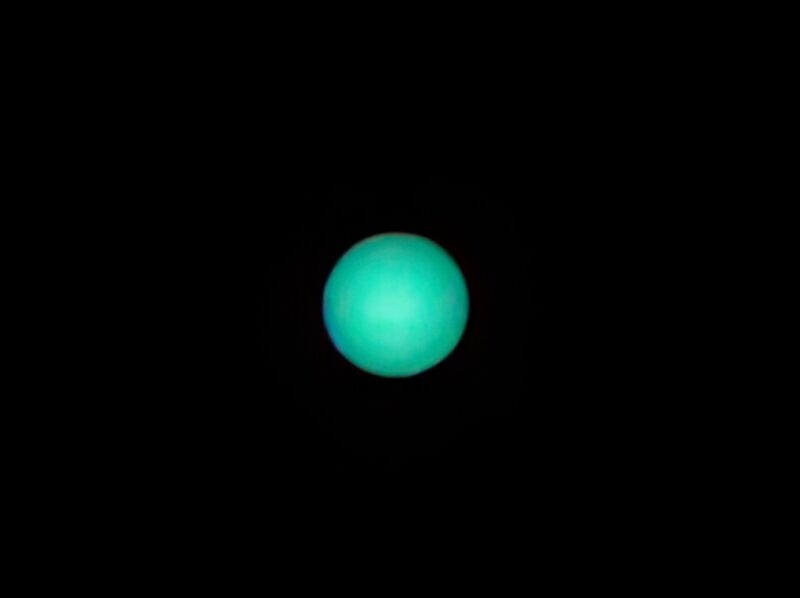
Our planet Earth will swing between the sun and the 7th planet – Uranus – at 23 UTC on November 25, 2026. That means we’re now smack in the middle of the best time of year to see this outer planet. Have you ever spotted the planet Uranus? Indeed, it’s theoretically possible to see with the eye alone. But, in practice, Uranus is tough to locate without optical aid. Still, it’s easier when Uranus is opposite the sun. That’s because it’s rising in the east as the sun sets in the west, highest in the sky at midnight.
Uranus at opposition
When and where to watch in 2026: Uranus is theoretically visible to the unaided eye – assuming you have good eyesight – and you are under a dark sky. And the planet is easily visible in good binoculars or a telescope. By the time of its November 25 opposition, Uranus is rising in the east at sunset and visible all night. It’ll remain in the evening sky through April of 2027.
Opposition for Uranus will fall at 23 UTC on November 25, 2026. That’s 5 p.m. CST.
Brightness at opposition: The 7th planet shines most brightly for 2026, at magnitude +5.6. In fact, Uranus shines at this brightness from about mid-October to mid-December. So, it should be possible to glimpse Uranus with the unaided eye, if you have dark-sky conditions. Find printable finder charts for Uranus at In-the-Sky.org.
Distance from Earth: At opposition in 2026, Uranus is at its least distance from Earth at 2.6 light-hours or 18.4 astronomical units (AU).
Constellation at opposition: At this 2026 opposition, Uranus is in front of the constellation Taurus the Bull. And it’s near the Pleiades star cluster making it a bit easier to locate.
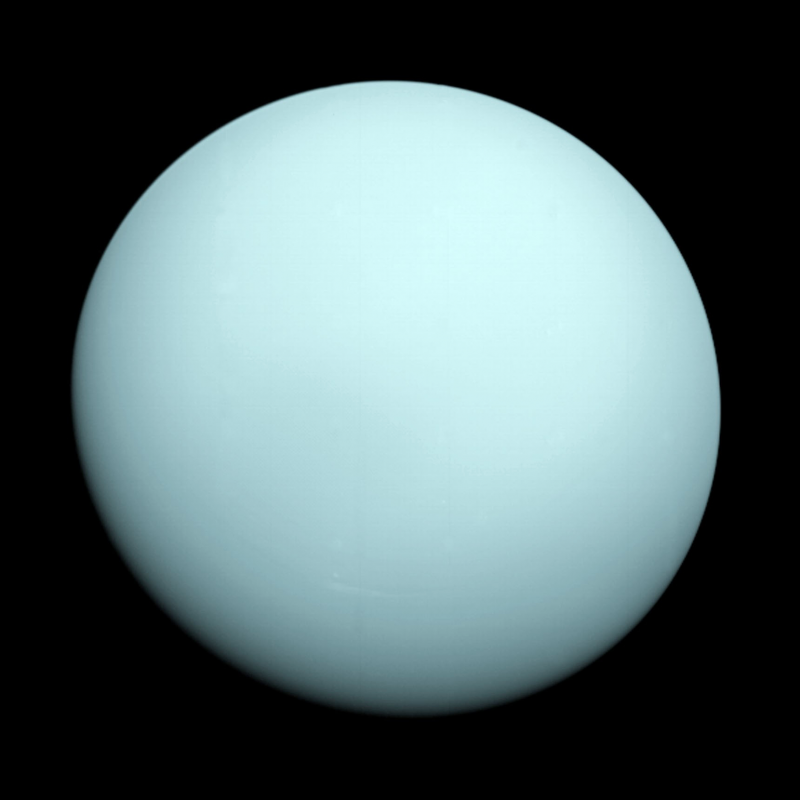
Through a telescope: Uranus appears as a tiny, greenish disk 3.8 arcseconds across. In addition, look for up to four moons of Uranus as well.
Note: William Herschel discovered Uranus in 1781. It was the first planet to be discovered in modern times, and the first to be discovered with a telescope. It expanded the known limits of our solar system. Herschel called the new planet “the Georgium Sidus” (the Georgian Planet) in honor of King George III of England. However, the other planets were named from classical mythology. So the German astronomer Johann Elert Bode later suggested Uranus, in order to bring Uranus into conformity with the other planets’ names. In mythology, Uranus is the ancient Greek deity of the heavens, the earliest supreme god. His mythological granddaughter, Urania, is the goddess of astronomy. The name Uranus for this planet didn’t come into common use, however, until 1850.
Quick facts about oppositions
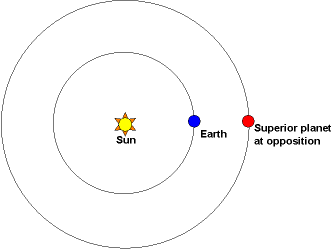
The period around opposition is the best time of the year to see an outer planet, and opposition itself is the moment at the center of that optimal viewing period.
Think of us on Earth, sweeping between the sun and Uranus in our smaller, faster orbit. Plus, around the same time as Uranus reaches opposition, it is also making its closest approach to Earth.
Read more: What does opposition mean for an outer planet?
For precise sun and Uranus rising times at your location:
Old Farmer’s Almanac (U.S. and Canada)
timeanddate.com (worldwide)
Stellarium (online planetarium program)
In-the-sky information and finder chart from your location
View from above the solar system, November 2026
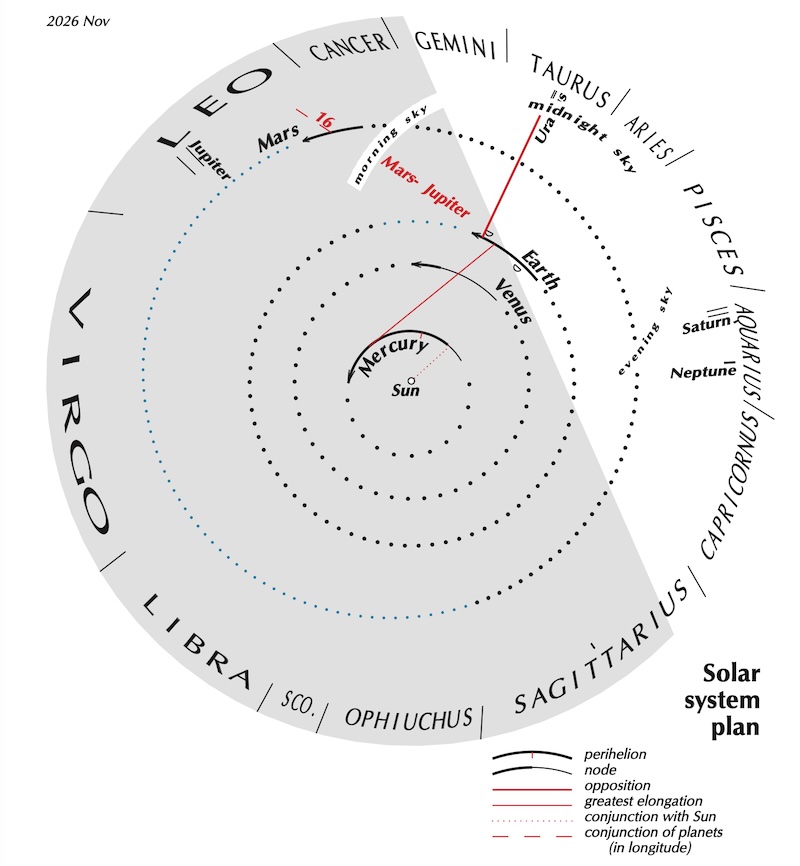
How often is Uranus at opposition?
Uranus is the 7th planet from our sun. And a year on Uranus is 84.4 Earth-years long. So, because Uranus’ orbit around the sun is so gigantic, and because Earth whips around the sun so quickly in comparison, Uranus’ opposition date falls about four days later each year.
2024 Uranus opposition – November 16
2025 Uranus opposition – November 21
2026 Uranus opposition – November 25
2027 Uranus opposition – November 30
Earth and Uranus at opposition
Our planet Earth swings between the sun and Uranus on November 25, 2026, placing us right at the best time of the year to see the outer planet. Why? Because in November 2026, Uranus is opposite the sun in our sky. It rises in the east as the sun sets in the west.
And because Uranus is opposite the sun in November 2026, it climbs highest for the night at midnight (midway between sunset and sunrise). So, Uranus stays out all night long. Also, around the time of opposition, Earth’s motion brings Uranus closest to Earth for 2026. The planet shines at its brightest in our sky. How bright is that? Not very bright.
The fact is, even at its brightest, Uranus is still quite faint. Indeed, it’s barely perceptible as a dim speck of light to the unaided eye, even under dark skies. At a magnitude +5.6, Uranus shines no more brilliantly than the sky’s faintest visible stars. Given a dark sky free of light pollution, you might see Uranus with the eye alone. But you’ll need to have a good finder chart to know right where to look for this distant world in the constellation Taurus.
Distance to Uranus
In fact, at its closest point to Earth, Uranus is still twice as far away from us as its next-door neighbor, Saturn. At opposition, Uranus will be just shy of 19 astronomical units away from Earth and about 20 AU from the sun. (One astronomical unit equals the average distance of Earth from the sun).
Other Uranus observing opportunities
While opposition is mathematically the best time to view Uranus due to its nearness and brightness, another great opportunity is when the dim planet is near a brighter, closer planet, or near the moon. For example, when a bright planet passes close to distant Uranus as seen from our point of view, we get an easy guidepost to point us to the gas giant. In fact, Mars will pass 0.1 degrees south of Uranus on July 4, 2026.
Plus, in 2026, it’s near the Pleiades star cluster making it a bit easier to locate.
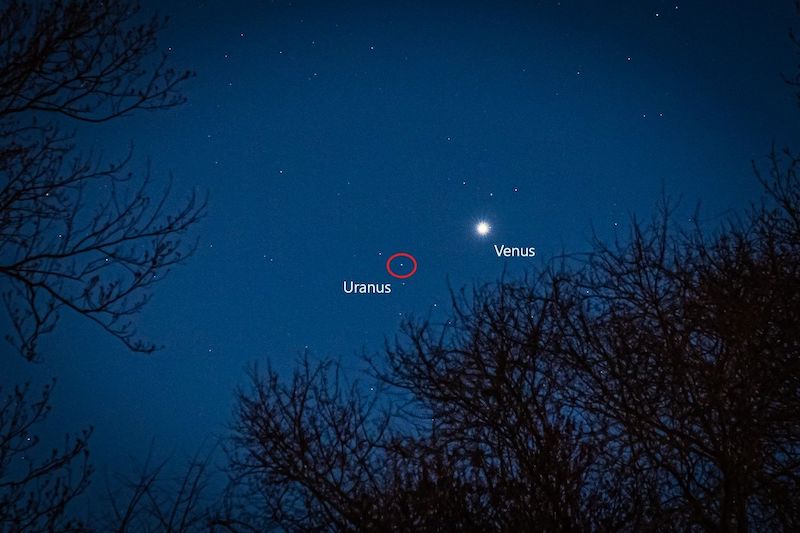
Bottom line: Uranus reaches opposition on November 25, 2026. So, at this time, it’s brightest for the year and visible to the eye under optimum observing conditions. Here’s how to see it.
Read more: Seasons of Uranus, a sideways world with strange seasons
Like what you read?
Subscribe and receive daily news delivered to your inbox.
More from
Deborah Byrd


Visible planets and night sky guide for October

Cassiopeia and Perseus on October evenings
Orionid meteor shower 2026: All you need to know
See brightest star, Sirius, in your morning sky



